The Resurgence of the Bound Leaf
We have all experienced the fleeting unreality of modern reading. We scroll through thousands of words on backlit glass panels, only for those passages to vanish beneath an incoming alert or refresh cycle. In contrast, when we hold a hand-bound codex, we immediately confront a structural discipline that has barely altered since the early centuries of the common era.
Many of us come to hand bookbinding seeking relief from screen fatigue, expecting a charming craft afternoon. What we discover instead is an unyielding masterclass in material physics. Paper is not an abstract planar white canvas; it is a woven mat of cellulose fibres possessing grain, moisture memory, elasticity, and temper. If we fold a sheet perpendicular to its natural grain direction, the spine cracks and buckles under atmospheric changes. When we respect the grain, folding parallel along the fibre alignment, the page falls open with a quiet, supple obedience.
Signatures, Bone Folders, and Sewing Frames
In our workshop routines, the binding process commences with the gathering of leaves into nested sections known as signatures. Typically, four or five folded sheets are nested together, yielding sixteen or twenty page surfaces. To sharpen each crease without burnishing or tearing the paper surface, we employ a genuine cattle bone folder. Modern nylon spatulas flex too much; real ox bone absorbs microscopic friction heat and leaves a crisp, permanent fold.
Next comes the piercing of sewing stations with a slender bookbinder awl. Here, geometry matters. If holes are pierced too wide, paste seeps into the text block during glue-up; if too narrow, the linen thread tears the paper fibres under tension. When we erect our linen sewing tapes on an upright wooden sewing frame, we see the architectural spine of the book take shape. Signature by signature, we sew kettle stitches at head and tail, drawing the thread snug without strangling the spine.
- Unbleached Linen Thread: We wax natural linen thread with pure beeswax to eliminate knots and prevent moisture-induced mildew over decades.
- Sewing Tapes and Cords: Linen webbing bands span across the joints, anchoring the sewn text block to the cover boards with durable flexibility.
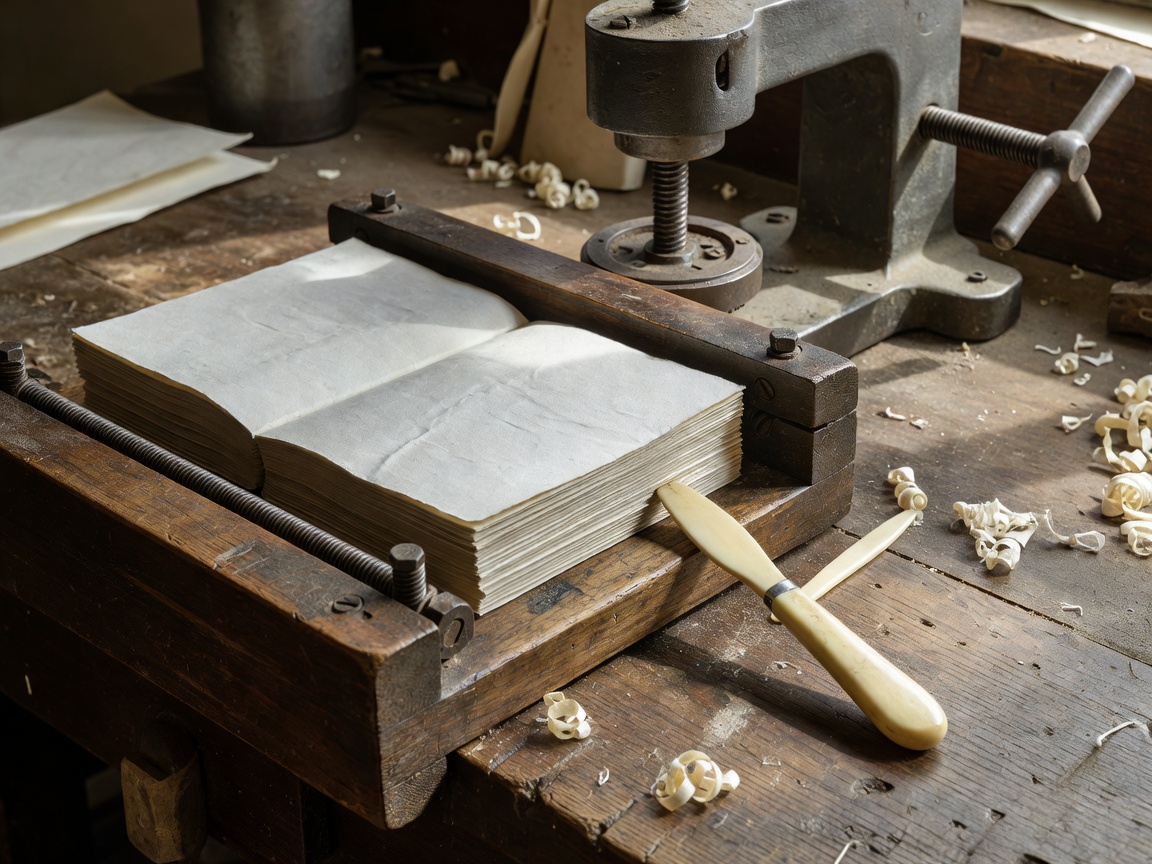
- Laying Press and Plough: Wooden screw presses hold the compressed block rigid while a handheld plough blade trims edges flush.
Comparing Binding Structures: Coptic, Case, and Flexible Spine
When selecting a binding methodology, we balance the intended use of the blank book against structural durability. An exposed spine structure behaves very differently from a hardbound case binding:
| Binding Style | Spine Exposure | Opening Angle | Optimal Application |
|---|---|---|---|
| Coptic Sewing | Open chain stitch spine | Lays flat 360 degrees | Sketchbooks and visual notebooks |
| Quarter-Cloth Case | Covered board and cloth spine | Opens comfortably to 180 degrees | Written journals and reference texts |
| Flexible Leather Spine | Moulded over raised cords | Traditional arched opening | Archival registry and heavy volumes |
The Chemistry of Adhesives: Wheat Paste Versus PVA
We often debate the virtues of modern polyvinyl acetate (PVA) versus cooked wheat starch paste. Polyvinyl acetate dries rapidly and forms a strong, rubbery film that resists fungus. However, PVA cures almost irreversibly. Once a modern polymer glue enters paper fibres, future conservators cannot easily undo the binding without chemical solvents.
Cooked wheat starch paste, by comparison, requires patient preparation. We whisk refined wheat starch in distilled water over a low flame until it transitions from milky opacity to a translucent, viscous gel. It dries slowly, granting us twenty or thirty minutes of working time to align delicate headbands and book cloth. Most importantly, wheat starch paste remains water-reversible. Two hundred years from now, another binder can dampen the spine and release the signatures unmarred.
By engaging with these historical adhesives and manual stitches, we step outside the throwaway economy. We produce an object designed to outlive its creator, rewarding the quiet patience invested in every fold.