The Tyranny of Infinite Digital Exposures
When our smartphones and digital bodies allow us to fire bursts of ten frames per second, we rarely pause to look at what is directly before us. Storage costs have shrunk to near zero, and with that disappearance of friction, the act of seeing has grown distracted. We photograph everything in duplicate, hoard thousands of uncurated sensor raw files, and rarely spend more than half a second admiring the result.
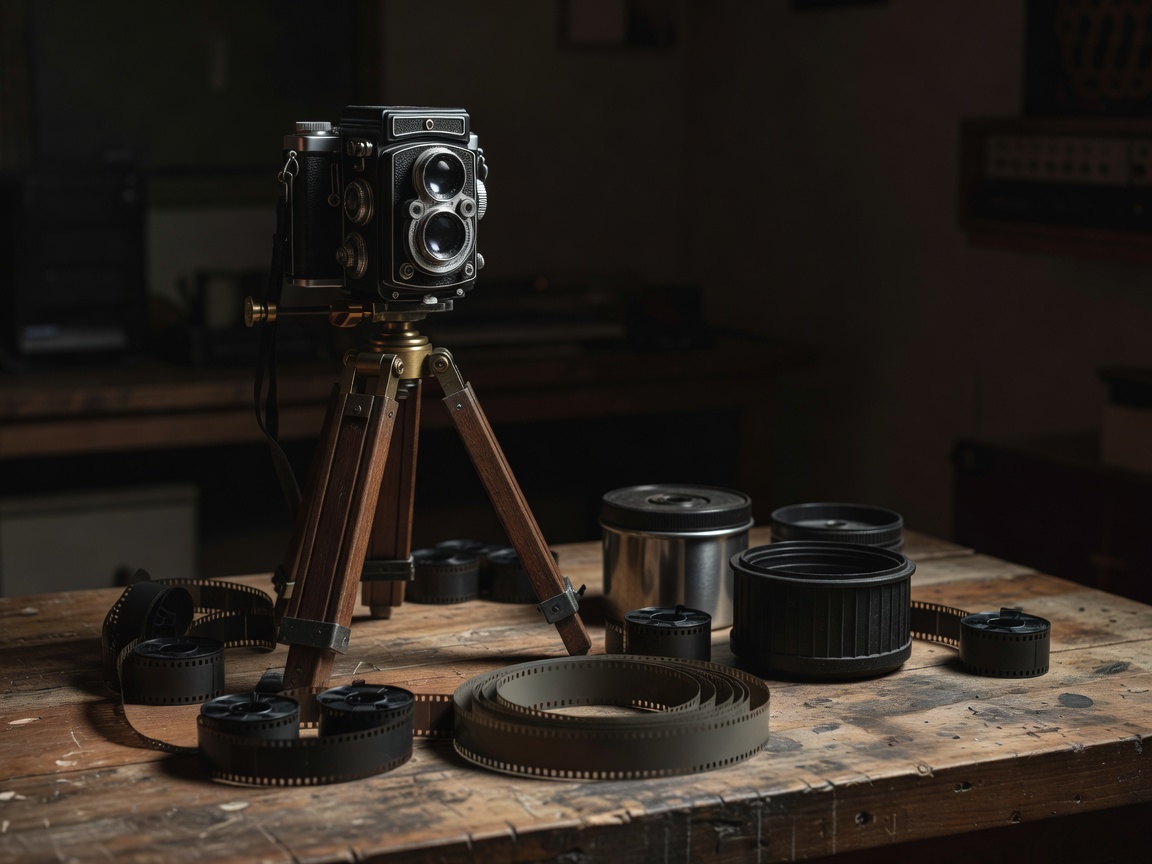
The return to analogue emulsion film represents a conscious rejection of this frictionless glut. When we load a canister of 35mm black-and-white film into an all-mechanical body, our relationship with time and light undergoes an immediate pivot. Every click of the winding lever costs money and commits a specific rectangle of gelatin emulsion. We find ourselves slowing down, checking the corners of the optical viewfinder, evaluating shadow densities, and waiting for the decisive gesture.
Format Trade-Offs: 35mm Cartridge Versus 120 Medium Roll
We often discuss whether newcomers to analogue practice should begin with standard 135 perforated cassettes or step directly into 120 medium format roll film. Both paths offer distinct mechanical disciplines:
| Format Feature | 135 Format (35mm) | 120 Medium Format |
|---|---|---|
| Frame Yield | 36 exposures per canister | 12 frames (6x6) or 8 frames (6x9) |
| Film Loading | Felt-lipped cassette, automatic take-up | Paper-backed spool, manual tensioning |
| Grain Structure | Prominent, visible grain character | Smooth tonal transitions, fine gradation |
| Equipment Mass | Compact, handheld rangefinders & SLRs | Substantial bodies, waist-level viewfinders |
The Chemistry of the Developing Tank
In our own darkroom work, the process of developing black-and-white film relies on precise physical variables: water temperature, developer dilution, agitation rhythm, and fixing duration. In pitch darkness, we unspool the exposed film inside a changing bag, feeding the delicate plastic ribbon into spiral reels before sealing the light-tight tank.
Once the tank is sealed, we mix classical developers such as Kodak D-76, Ilford ID-11, or Rodinal. Developing agents reduce exposed silver halide crystals into metallic silver grains. Agitating the tank for five seconds every minute introduces fresh chemistry to the emulsion while preventing bromide drag streaks. A water stop bath arrests the reaction immediately, followed by an acidic ammonium thiosulphate fixer that dissolves unexposed halides, rendering the negative permanent and impervious to daylight.
- Temperature Control: We hold chemical solutions within half a degree Celsius of the standard 20°C benchmark to avoid contrast shifts.
- Inversion Agitation: Regular gentle inversions ensure uniform density without producing excessive edge turbulence along the sprocket holes.
- Archival Wash: Washing in running water for twenty minutes removes residual thiosulphate compounds that would otherwise yellow the base over decades.
The Delayed Gratification of Latent Imagery
The defining psychological element of analogue film is the delay between conception and realization. There is no rear LCD screen on an antique camera. We cannot glance down to reassure ourselves that our aperture was correct or that our subject kept their eyes open. We must trust our knowledge of the exposure triangle—aperture, shutter speed, and film sensitivity—and walk away.
Days or weeks later, hanging wet film negatives to dry in a dust-free cupboard, we inspect the dripping ribbons with a magnifying loupe. Seeing the subtle gradations of light captured chemically on acetate brings a quiet exhilaration that no digital histogram can duplicate. We realize that the value of the hobby was never instant speed; it was the deliberate attention required at every step.